
It’s intuitive to expect any benefit or condition of being an ECF member to apply throughout the period of membership, and this used to be so, until they started ‘Rolling Membership‘, under which there can now be a fee liability for some of the games you play whilst a member, making the above statement false. If you’re not aware of this, the following explanation may clarify. If you are au fait with this change, skip to ‘What changes could NECL make’.
How so? – Traditionally, when you joined ECF, or renewed, the annual membership applied to the whole of the current playing season. Regardless of when you paid, membership included free grading of all games played throughout that season. Prior to 2011, new grades were calculated annually, at the end of each season; then twice yearly, Jan and July; until 2020, when grades were calculated and published monthly – though game fees, often called grading fees, have been charged annually throughout. These are invoiced to leagues after the end of each playing season and clubs have contributed their share of this after checking with their players.
|<=================== playing season =======================>|
|<================= membership period ======================>|
|<================ free grading period =======================>|
Up to 2017, ECF charged a set amount per graded game, so those who played fewer games would often wait to decide if it was cheaper to pay that instead of paying a membership fee. Then, ECF decided it was uneconomic to chase small payments and set game fees to be the same price as bronze membership, but apply to any number of games above a free quota of 3, per league (or per club for graded internal club games). Game counts of non-ECF-members was therefore shown in player lists on the NECL website to help track this, and those likely to play more than 3 graded games in the season were encouraged to join (or renew). Although clubs could not guarantee a non-member will join/renew, they could delay inclusion in team selections until ECF membership is assured, as paying a subscription up front was preferable to later having to cover invoiced fees (and more economic for players who play in more than one league, or have internal club graded games, as the same level of fee is repeatedly invoiced to each ‘cost-centre’ where the quota is exceeded). Applications in process were taken on trust to complete so overall there tended to be only a SHORT period of uncertainty before player, club and league all knew where they stood.
When ‘Rolling Membership‘ started in 2023, you are now regarded as a member for 12 months from the beginning of the month in which you pay to join/renew, which can now generally span parts of two playing seasons. However, ECF considered it inconvenient to shift the grading period in line with this new period of membership, causing confusion by staying with the traditional system of free grading of all games played in the season of joining/renew!
|<======= playing season 1 ======>||<======= playing season 2 =======>|
……………………|<===== membership period 1 =====>|
|<===== free grading period 1 =====>||<== ?? grading period 2 ?? …..
Now, membership period 1 , as sketched above, still covers games played in free grading period 1 – but does NOT cover ANY graded games played in playing season 2. This is where the issue begins! LONGER periods of uncertainty now arise during playing season 2, particularly where players renew mid-to-late-season.
Impact? – Under this new system, liability for potential game fees now starts after reaching quota in playing season 2 and lasts for the remainder of membership period 1. Games in this period are assumed covered by payment for membership period 2 (if/when that happens).
I use the term ‘liable members’ for players in period 1 of their membership who are playing graded games in playing season 2. Their membership expiry is before 30th June in playing season 2. For game fee purposes, we are now having to regard them on a par with non-members, with a new requirement to track their game counts in player lists on the NECL website to identify potential game fees. Some ‘liable members’ found this hard to accept.
After the now longer period of uncertainty, if a player doesn’t renew, who should fund any game fees invoiced for grading period 2? – ECF tried to put this on to the league.
Item 2 of their ‘Membership, Pay to Play and Game Fee’ notes says
“Important – Liability to pay any game fee lies strictly with the league which has made the rating submission, and cannot be derogated to the club(s) or individual players.”
and Item 2 of their invoicing policy says:-
“By submitting game results to the rating server, organisations accept liability for any pay to play or game fee that is incurred.”
This ‘liability’ on a league, or tournament organiser, is highly questionable (and how else would leagues fund potential game fees, if not via clubs/players?). ECF membership is contracted between player and ECF. When leagues submit match results, they can not ensure a player will be an ECF member at a future date (30th June of season 2) so might not readily accept incurring a debt to ECF just because a further contract between a player and ECF does not take place. Somehow, without consultation or prior-agreement, ECF switched to expecting leagues to anticipate and secure funding for future invoicing when neither league, club nor player can guarantee future renewals, in situations where expiry of current memberships can now be several months away, having made a change that effectively takes away the former leverage clubs had for ensuring immediate renewals! – so not a positive influence!
It is not practical to await renewals by liable members before picking them for team matches – and It would be totally unreasonable to meanwhile disallow further participation upon reaching quota! Also, those players would not expect to be asked to pay for membership period 2 in advance, just to avoid potential fees for the games they are now playing in playing period 2 – and even if some players want to give reassurance by paying the future renewal in advance, ECF currently do not even allow this until near expiry. ECF state that
“Membership can be renewed on the existing level from 28 days before the membership expires.”
On say 50 non-renewals @£21 (unusual but possible), ECF would expect the league to be liable for £1050! Measures had to be taken to offset this, which required extra work. The NECL treasurer now has to manage a game fee reserve fund, made up of transfers-in from club treasurers. The NECL webmaster had to facilitate this in the on-line accounts as well as the extra tracking to easily identify liable members for monitoring by club and league treasurers. Clubs can monitor game counts on club and player web pages and club officers can check club account balances to see if any action is needed by the club treasurer (who gets an email reminder from the league treasurer when a player reaches quota). Also, the similar league-wide list of players (select ‘Players’ on the main navigation panel) has an option to show only players of most interest to treasurers by filtering on those who have reached or exceeded quota in league or club games (select the link ‘only show players reaching or exceeding game fee quota‘), or go to https://necl.org.uk/playerlist.php?aoq=1.
It also shows if reserved funds are in place to cover each player. e.g.
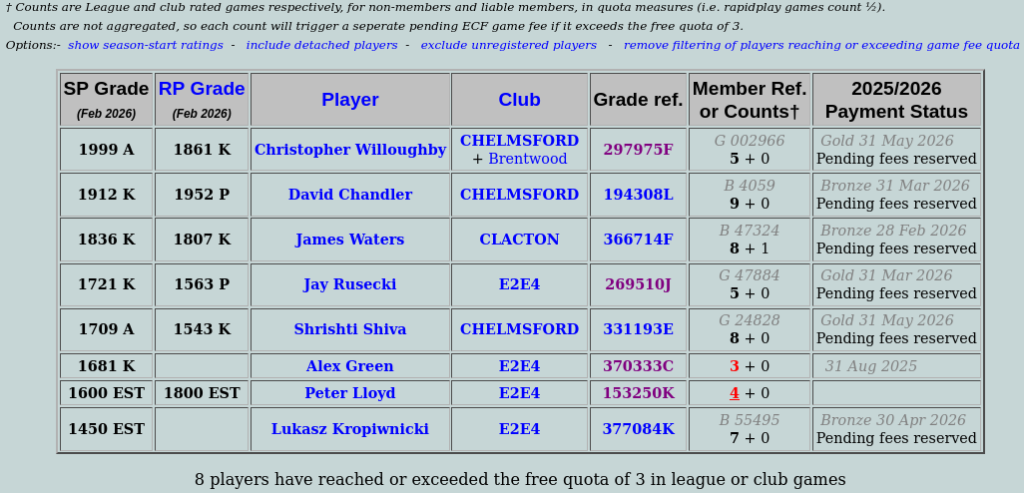
If/when players join/renew, their reserve is transferred back to their club account.
This arrangement was formalised at NECL AGM with rule 22b changed to state:-
…. “Any players incurring a pending fee to ECF via NECL will be ineligible whilst
their club has insufficient credit to cover all of such players’ fees.“
to encourage funding for game-fee reserves – but, if/when overlooked, game points are lost due to the ineligible player, the played game is still graded, but ‘liability’ unchanged.
How could ECF help?
1. Revert to previous system – unlikely now the step has been taken and ‘benefit’ declared?
ECF claim players now get “a full year membership”. Dubious? – as this was already the case for grading purposes if you’d already played games in the season you joined (but not for ‘benefits’ such as discounts on goods from partnering sites – so if ECF regarded this as the main reason for change, it might have been possible with time-limited-discount-codes instead?). Arguably, players who only started a series of graded games when joining still don’t get “a full year membership” – but would do if …
2. ECF could restore grading periods to again be in line with each player’s membership period. This would, a) restore the status quo to what most players intuitively expected, and b) restore previous club leverage (though the invoicing process may need to become monthly instead of annual) – otherwise …
3. Clearly state on joining/renew form T&Cs that members may be liable for game fees in respect of games played up to 30th June within the season of membership expiry, if not renewed by that date. Why would a player not accept this? – or ..
4. Provide a means to pay part/extended renewals to help players synchronise to an early-season-renew cycle, that would help reduce periods of uncertainty and ease the required size of club/league floats at no extra long-term expense to players. When I asked ECF on this (Oct 2024), they said it had been considered but decided to not allow it. Hence, destined to perpetuate – again, not a positive influence!
5. Not invoice/charge leagues for games by ‘non-renewing-liable-members’ played while they were members, as leagues have no control over this cost. If uneconomic to obtain the fee immediately from members, ECF could add this charge if/when they next wish to rejoin.
What changes could NECL make?
We have discounted disallowing further participation by liable members when they reach quota as being unreasonable. Failing any of the above listed actions being taken by ECF, NECL could;
1. Ring-fence a set amount (e.g. up to a defined proportion of the league balance?), to be used as a general game fee reserve float and just recover any end of season liabilities from clubs? – avoids many in-season dialogs and ‘to-ing and fro-ing’ of pending reserves.
2. Delay submissions to grading for results of all games that involve a new or liable-member who has reached quota – until such date that membership status as of 30th June of the current season is verified. This is because the stated assertion of league liability by ECF rests on the action of the league making the grading submission – so no submission – no liability! This would of course also delay the normal grading process for opponents, and many players now expect to see grade adjustments on a monthly basis (and due to previously clarifying with ECF that ‘events’ be submitted in entirety or not at all, the full match result should possibly be delayed?) – with a knock-on effect of causing small differences in published grades during the season, compared to there being no delay. This could dispense with the need for a grading reserve fund, though tracking is still needed.
3. A more drastic measure is to not submit games for ECF grading at all and instead use a local equivalent calculation. Again, no submission – no liability! – but contentious – as it depends on what value club members place on having an ECF authenticated grade? Some will consider it essential and be ECF members anyway though maybe play fewer league games. Others may simply just prefer to not pay an ECF membership – which has happened in the past, (e.g. Yorkshire had it’s own system until 2018, despite issues raised with the BCF as to formula being patent-able, or not, and data it produced being copyright-able, or not, with attempts to charge for this).
About 185 players are registered to play NECL league – worth about £4k annual revenue to ECF. The number of potential game fee liabilities at any one time mostly stays within single digits.
4… Other suggestions or comments?
Update: There may be an indication of ECF now recognising their earlier liability dictate was not being readily accepted – in the following wording of the 2025/26 version of the “game fee document”;-
“Players who were ECF members at Bronze level or above in the relevant league season at the time all of their league games were played. Clubs are asked to check any game fee invoices they receive and bring to the ECF Office’s attention any instances of players who were not members as at 30th June but were members at the time they played all their games in the preceding season. For example, players who are not members as at 30th June 2026 will be expected to have been ECF members at Bronze level or above for all the games they played in the preceding 2025/2026 season. If players satisfy that condition, we will always consider a waiver for such cases when they are brought to our attention.”
Presumably ECF would require settlement of outstanding amounts from the player before they can renew in the future, so as not to allow playing the system. The wording is still somewhat ‘high-handed’ though, putting the onus on leagues to check details and ‘appeal’ to be ‘considered’ for a ‘waiver’! The conditional of being a member for all league games played in a preceding season is the norm for NECL so could lead to a restoration of the former/pre-rolling leverage – but present ECF wording still allows for waivers to be declined without explanation.
Instead, leagues might reasonably expect ECF, who have full game and player details, to simply not invoice fees for league games played whilst a player was a non-rejoining liable member (and therefore were full members in the said proceeding season) – and any exceptions that accidentally get through and pointed out by leagues could be considered an error on the part of ECF, rather than insist the league appeal for a waiver? i.e. Leagues agree to game fee payments only for games played while a player was a ‘non–member’ (ideally none), but not for games played during membership ‘ – and then the answer to the title of this article would become ‘true’ after all!
Further Update (April 2026): An undated ECF council document published here gives further insight. A copy with my comments, along the lines of this article, is shown here.